Saving Material in Cable Inspection
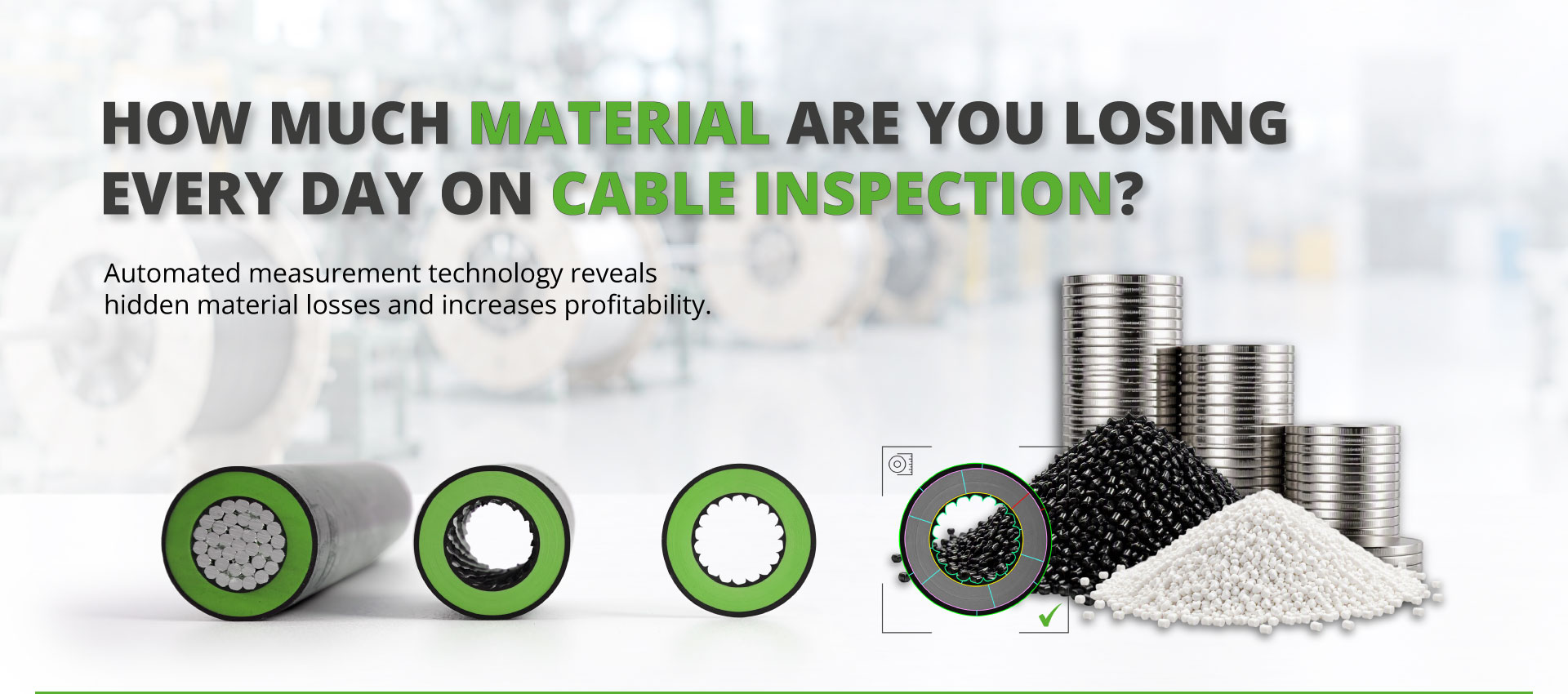
How much material are you losing every day on cable inspection?
Automated measurement technology reveals hidden material losses and increases profitability.
Plastic insulation accounts for a large share of the manufacturing cost of a finished cable.
Even so, in many extrusion lines a measurable percentage of this material leaves the plant purely as a safety margin:
core insulation and sheaths are applied thicker than necessary — simply because nobody knows exactly how thin one could safely go.
This is precisely where automated measuring instruments come in. This article takes a factual look at where they actually help cable manufacturers save material.
Avoiding Excessive Material Consumption: Strategies for Reducing Material Use in Cable Production
Reducing this overconsumption usually does not require new machinery, but better measurement data.
Where overconsumption comes from
Overconsumption rarely stems from carelessness. It is the logical consequence of uncertainty. If it cannot be reliably determined how much material is actually on the product, the tendency is to aim at the upper tolerance limit of the product specification.
The greater the measurement uncertainty, the larger this safety buffer has to be.
Manual measurement on a profile projector is a good example.
An exact statement about the actual value of the minimum wall thickness is virtually impossible. The result depends on the operator and their skill.
Two operators can arrive at different values on the same sample, and the same operator will very likely obtain different results at different points in time.
Since this scatter is real and known, it has to be absorbed somewhere — and it is absorbed in the form of additional material.
The standard-compliant measurement is not the actual cross-section
There is a second, less obvious source of overconsumption: the difference between what the standard prescribes to be measured and what is actually paid for.
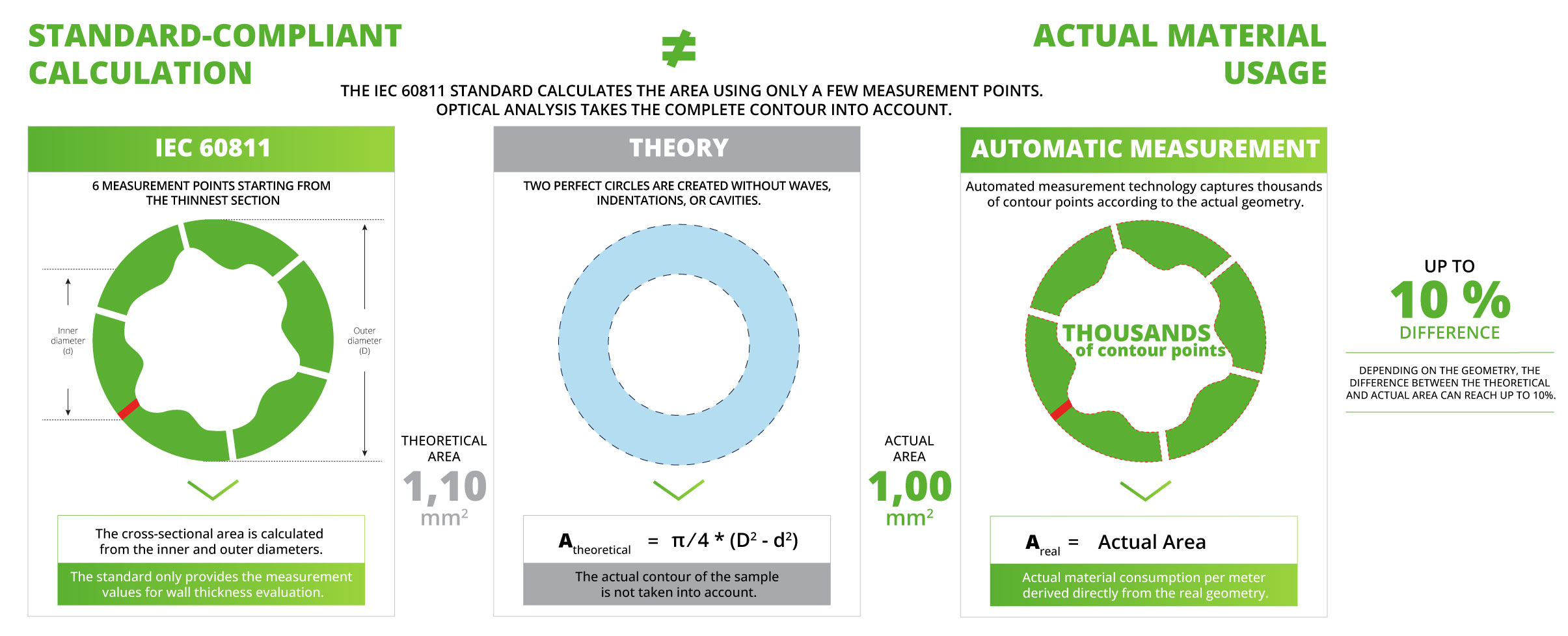
IEC 60811 typically defines the procedure for determining wall thickness values at 6 defined points, as well as the calculation of the inner and outer diameter.
The area required to calculate the material consumption is then determined by calculating the area between the identified inner and outer diameters. Because this method does not consider the complete contour of the insulation, considerable differences arise between reality and theory.
The gap becomes visible with insulation that is not "perfectly" cylindrical (e.g. 3-core sheathed cable, stranded wire jacketing). A helpful image is the cross-sectional area of a cauliflower: if you measure its diameter with a caliper at 3 positions, you obtain 3 values. The actual surface, however, is highly irregular, and the real area enclosed by this contour does not correspond to the area of a smooth circle of the same diameter.
Depending on the geometry, the difference between the cross-sectional area derived from standard-compliant wall thickness measurements and the actually measured area can reach around 10%.
An automatic optical measuring device determines the actually enclosed area of each layer directly from the cross-sectional image and thousands of contour points, instead of deriving it from individual point measurements. This makes it possible to calculate the real material consumption per meter and compare it with the theoretical consumption from the nominal specification. The difference between these two values is the overconsumption.
Tolerance reduction as a practical lever
Once overconsumption has been quantified, it can be controlled. Two levers are available for this:
Narrowing the process window:
A repeatable, operator-independent measurement available in minutes rather than hours allows tighter internal tolerances without increasing the risk of falling below the specified minimum value. The safety buffer that previously had to cover measurement uncertainty can be reduced.
Continuous analysis of overconsumption:
Monitoring overconsumption — that is, the deviation between actual and nominal material input — can be developed into a production KPI.
Assessing profitability
The return on investment for an automatic insulation measuring device such as the VCPX5 is carried entirely by the compound saved and the working time saved. The relevant input variables are manageable: annual production volume of a product, material cost per kilogram, and the overconsumption currently present, in percent. An amortization calculation on this basis is typically dominated by a single high-volume product.
ROI Calculator VisioCablePro®
Conclusion
Saving material in cable production is at its core an information problem. Conformity with IEC 60811 proves that a product lies within specification; it does not, however, show how much material is being given away within that specification. Measuring the actual cross-sectional area closes this gap and turns the trade-off between safety margin and material cost into a conscious, controllable decision.
A benefit that goes well beyond time- and material savings alone.
The key question
The question is not whether savings potential exists.
The question is: do you already know it?
Let us show you the time savings potential within your production line.
Talk to an expert
We are here to support you.
Your VisioCablePro® Team